Main11 {
public static void main(String[] args) {
System.out.println(checkBrackets("()((())"));
System.out.println(checkBrackets("())(())"));
System.out.println(checkBrackets("()(())"));
}
/**
* 检查str中的括号是否匹配
*
* @param str
* @return
*/
public static boolean checkBrackets(String str) {
if (str == null || str.isEmpty()) {
throw new NullPointerException("待检测的字符串不能为空");
}
if (!str.matches("[\\(\\)]+")) {
throw new RuntimeException("待检测的字符不能包含除'(',')'以外的字符");
}
Stack<Character> stack = new Stack<Character>();
for (int i = 0; i < str.length(); i++) {
char c = str.charAt(i);
if (c == '(') {
stack.push(c);
} else {
try {
stack.pop();
} catch (Exception e) {
return false;
}
}
}
return stack.isEmpty();
}
}
/**
* <p>
* 栈
* </p>
* <p>
* 这里只是对LinkedList作简单的封装来模拟一个栈结构
* </p>
*
* @author D.K
*
* @param <T>
*/
class Stack<T> {
private LinkedList<T> list;
public Stack() {
list = new LinkedList<>();
}
public boolean isEmpty() {
return list.isEmpty();
}
public void push(T t) {
list.addLast(t);
}
public T pop() {
return list.removeLast();
}
}
结果:
3. 队列(queue)
在队列上的insert操作被称为enqueue(入队),而delete被称为dequeue(出对)。在现实生活中,我们在购物结账时所排的队就像队列数据结构一样(先到的人排在对列的前面,先结账,先离开)。
如下图,描述的是队列Q在进行enqueue和dequeue操作的过程。队列有head(对头)和tail(队尾)。队列中的元素存放在Q.head与Q.tail-1之间。队列是首尾相连(环绕)的。初始时,Q.head = Q.tail = 1。当Q.head = Q.tail时,队列是空的,如果试图从空队列中删除一个元素,则发生队列下溢;当Q.head = Q.tail+1时,队列是满的,如果试图在满队列插入一个元素,则发生队列上溢。
下面给出队列实现的伪代码(省略了溢出检查)
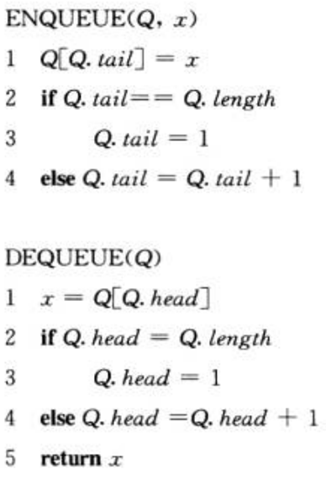
下面我们来看一个应用队列的例子。(例子借鉴自:http://www.cnblogs.com/shenliang123/archive/2013/02/16/2913552.html)
在密码学中,恺撒密码是一种最简单且最广为人知的加密技术。据传是古罗马恺撒大帝用来保护重要军情的加密系统(不太可信)。它的具体做法是,将待加密的英文字符串的每个字母以字母表的顺序移动一定的位数来实现加密。这是很容易被破解的,因为移动的方案只有25种(假设每个字母移动相同的位数)。
现在我们来考虑一个类似但稍微靠谱点加密方式(其实通过对字母出现频率的统计还是很容易破译)。我们先事约定一组密钥(用队列来存放),然后把每个字符按字母表顺序向右移动密钥中对应位置上的数。下面给出Java实现代码:
public class Main11_2 {

    public static final Integer[] SECRET_KEY = new Integer[] { -1, 3, 2, 5, 9, 0 };

    public static void main(String[] args) {
        String originaltext = "good good study,day day up!";
        System.out.println("原文是:" + originaltext);
        // 加密
        String ciphertext = encrypt(originaltext);
        System.out.println("密文是:" + ciphertext);
        // 解密
        String plaintext = decrypt(ciphertext);
        System.out.println("明文是:" + plaintext);
    }

    /**
     * 加密
     *
     * @param plaintext
     *            明文
     * @return 密文
     */
    private static String encrypt(String plaintext) {
        String ciphertext = "";
        if (plaintext == null || plaintext.isEmpty()) {
            return ciphertext;
        }
        Queue<Integer> queue = new Queue<>(SECRET_KEY);
        for (int i = 0; i < plaintext.length(); i++) {
            char c = plaintext.charAt(i);
            int key = queue.dequeue();
            ciphertext += (char) (c + key);
            queue.enqueue(key);
        }
        return ciphertext;
    }

    /**
     * 解密
     *
     * @param ciphertext
     *            密文
     * @return 明文
     */
    private static String decrypt(String ciphertext) {
        String plaintext = "";
        if (ciphertext == null || ciphertext.isEmpty()) {
            return plaintext;
        }
        Queue<Integer> queue = new Queue<>(SECRET_KEY);
        for (int i = 0; i < ciphertext.length(); i++) {
            char c = ciphertext.charAt(i);
            int key = queue.dequeue();
            plaintext += (char) (c - key);
            queue.enqueue(key);
        }
        return plaintext;
    }
}

class Queue<E> {

    private LinkedList<E> list;

    public Queue() {
        this(null);
    }

    public Queue(E[] objs) {
        list = new LinkedList<>();
        if (objs != null) {
            for (E e : objs) {
                enqueue(e);
            }
        }
    }

    public boolean isEmpty() {
        return list.isEmpty();
    }

    public void enqueue(E e) {
        list.addLast(e);
    }

    public E dequeue() {
        return list.removeFirst();
    }
}
结果: